Last night saw Frances Hardinge's wonderful book, "The Lie Tree" crowned as Costa Book of the Year. Having faced down the hotly-tipped neo-gothic of Andrew Murray's "The Loney" alongside works by Kate Atkinson, Andrea Wulf and Don Paterson, this was a triumph not just for a fiercely entertaining, fiercely intelligent book but also for children's and young adult lit as a whole.
The Lie Tree itself has been described by Frances Hardinge herself as "a Victorian Gothic mystery with added paleontology, blasting powder, post-mortem photography and feminism", while I would describe it as a heady mix of E Nesbit, Wilkie Collins, MR James, Arthur Machen and Germaine Greer. It's a book that deserves to be read by anyone over the age of eight and I really can't recommend it too highly (though I'd recommend the extraordinary "A Face Like Glass", which is packed with more ideas than a symposiumful of string theorists, even more).
Wednesday, 27 January 2016
Wednesday, 20 January 2016
Once Upon a Very Long Time Ago
Fairy stories have been around for a very long time but exactly how long? The one thing we can be sure of is that most of them existed long before they were written down, especially given that many only entered print (in Europe at least) with the work of collectors and embellishers like Marie-Jeanne L'Héritier and her uncle Charles Perrault in the 18th Century and the Brothers Grimm in the 19th.
But now the BBC reports that researchers at Durham University believe that, using "phylogenetic comparative methods" they have found evidence that some tales might be up to 5,000 years old. Given that the techniques used were borrowed from biology and that, in the absence of some storytelling Rip van Winkle from the Bronze Age, we're never going to get definitive proof, it's easy to dismiss, or at least doubt the claims. Isn't it pleasing, though, to imagine a Bronze Age parent telling something that sounds very like "Jack and the Beanstalk" or "Beauty and the Beast" to a group of gathered children and think of them thrilling at the giant chasing Jack or the Beast being transformed into a man? And if you're not satisfied with the simple romance of that idea, well you can find delve into the full depths of the research here.
Sunday, 17 January 2016
A Map of Fairyland
Now here's a lovely thing: thanks to Slate and io9, I've discovered this 1917 map of Fairyland by British landscape painter Bernard Sleigh, which reveals the locations of everything from the caves mined by the Seven Dwarfs to the location of Avalon and the Gardens of Proserpine.
Sleigh himself was apparently rather obsessed with the idea of fairies, going on to write The Gates of Horn: Being Sundry Records from the Proceedings of the Society for the Investigation of Fairy Fact and Fallacy.
Those wanting a better look at the map can find it in all its glory up on its own Library of Congress page.
Sleigh himself was apparently rather obsessed with the idea of fairies, going on to write The Gates of Horn: Being Sundry Records from the Proceedings of the Society for the Investigation of Fairy Fact and Fallacy.
Those wanting a better look at the map can find it in all its glory up on its own Library of Congress page.
Tuesday, 12 January 2016
Perrault-Fashion
As you'll have noticed if you tried to Google anything today, it's the 388th birthday of Charles Perrault who, more than anyone else, kickstarted the fashion for collecting, adapting and refining fairytales in Europe. And some 200 years before the Grimms set to work, to boot.
There's a good quick summary of Perrault's life and work up at The Guardian, which also has a fun page about the lessons we should learn from fairytales, though no-one's yet mentioned the surprising durability of gingerbread as a construction material.
Wednesday, 7 October 2015
Dark Disney
A fun thing from ScreenRant (though I'd ignore the rather unfortunate image they chose at the front of the video): the dark, pre-Disney origins of some of our favourite fairy stories.
In fairness to Disney, there were lots of different versions of these stories and the Grimms produced more and more bowdlerised versions with each new edition. For anyone after an English version of the Grimms' first take on the tales, I can heartily recommend Jack Zipes' translation, published by Princeton University Press as "The Original Folk and Fairy Tales of the Brothers Grimm".
Sunday, 16 August 2015
Grimm Tidings
I've always loved Grimms' Fairy Tales. A quick scamper through my shelves reveals three copies and I suspect there must be others lurking around somewhere. Wonderful and strange, they haven't just entertained kids down the ages and provided the base of stories from which Disney propelled itself to world domination, they have also inspired countless artists and illustrators, as *ahem* illustrated by this selection over at Brainpickings.
Wednesday, 12 August 2015
Magic Swords!
Otherwhile isn't much for magic swords. Most swords do the work quite nicely (or, indeed, nastily) in the right hands anyway, so magic seems rather unnecessary. There's also a general lack of lake-dwelling types in samite, ready to fling out enchanted swords like a Dungeons & Dragons DM drunk on power and Cheeto dust.
The real world - our world - on the other hand, did have "magic" swords, complete with inscriptions on their blades. And the British Lilbrary would like your help with one of them. As you can read here.
Thursday, 12 March 2015
Buggrit.
Terry Pratchett was one of my heroes. His books made me laugh out loud in all sorts of embarrassing places and gave me more sheer joy than is entirely proper. The world is much less jolly without him. It's also less kind and less angry about injustice. If anyone understood the Ealing comedy idea of standing up for the little guy and girl (and troll and dwarf and vampire) it was him. He will be hugely missed. His books will still be hugely loved.
Saturday, 25 October 2014
The Lost City of the Crowfolk
Few have heard of the City of the Crowfolk and those few call it Lost. It was old when the Queens of Day were young, young only when The Absented dwelt in the World. It was the Crowfolk's capital, a jewel pillowed by the foothills of The Spine of the World. It lies where it has always lain, yet no woman or man or child seeks it out. Only the Crowfolk walk there and they walk there only in dreams.
It is large this Lost City and its buildings are tall. Though none have dwelt there for six hundred years, it has neither crumbled nor faded. Nor a snowdrop nor a daisy nor a blade of grass grows where it should not. No moss marks its walls, no lichen sits upon its wide, flagstoned roads. Not a fox pads over its streets nor does a mouse scuttle within its walls. And no birds sing.
There are no merchants on the Almond Way, no jewel-cutters on Bright Street. The dim halls of the Morthouse are shadowed only by their own stones, and the waters of the Three Fountains play unheard. The Tower of Ravens, so high, so high, looks down and sees nothing and naught. The City is Lost indeed.
It is large this Lost City and its buildings are tall. Though none have dwelt there for six hundred years, it has neither crumbled nor faded. Nor a snowdrop nor a daisy nor a blade of grass grows where it should not. No moss marks its walls, no lichen sits upon its wide, flagstoned roads. Not a fox pads over its streets nor does a mouse scuttle within its walls. And no birds sing.
There are no merchants on the Almond Way, no jewel-cutters on Bright Street. The dim halls of the Morthouse are shadowed only by their own stones, and the waters of the Three Fountains play unheard. The Tower of Ravens, so high, so high, looks down and sees nothing and naught. The City is Lost indeed.
Thursday, 25 September 2014
The Rage that Powers Writing
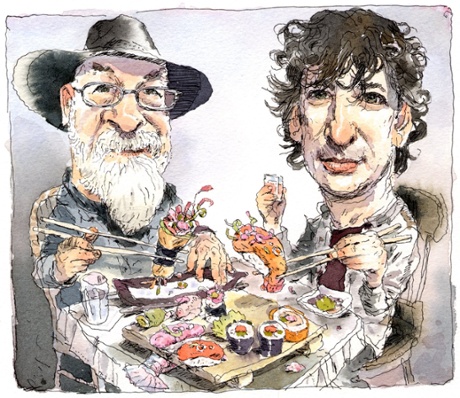
Not a particularly Otherwhilish update this but I wanted to share Neil Gaiman's article for The Guardian about his friend Terry Pratchett.
The article - warm and sad and unflinching in the way Gaiman does so well - is a great reminder of the way that anger can power writing and particularly comic writing. There is a deep hatred of injustice running through pretty much all Terry Pratchett's novels (particularly the Sam Vimes books). In a world in which we are all encouraged to see ourselves as individuals and to forget all those others without whom it would be impossible for us to survive and thrive, that's exactly the kind of hatred we need.
Tuesday, 23 September 2014
Beware Gargoyles
Among the biggest hazards of my writing life are gargoyles. I suspect that sentence needs some explaining. As you've probably guessed, I'm not talking about the stone grotesques that hang off the side of old churches and cathedrals and have a tendency to fall on vicars, squires and the like in rural murder mysteries. I'm not even talking about the gargoyles that come to life in horror movies. "Gargoyle" is the best term I've found for the ugly lines, phrases, sometimes whole scenes or chapters that crop up in one's writing (or my writing, anyway) from time to time and absolutely refuse to budge, no matter how many times you try to edit them away.
Having just chipped a particularly persistent gargoyle out of a script, I thought I would share some thoughts on gargoyle ecology - how they are born, how they survive and, most importantly, how to get rid of them.
How then are gargoyles born? There are several breeds of gargoyle, each born in a different way. The most common is the "Patch". These are born when you need to press on through a piece of writing - because of a looming deadline, say, or because you know there's a "really cool bit" that you're desperate to write lurking just a few more sentences away. This sort of gargoyle is slapped together quickly, an ugly thing meant to hide what would otherwise be an even uglier gap. It's always supposed to be short-lived but give it the slightest chance to stick its claws into your writing and there's a risk it will stay there forever.
The next type of gargoyle is the "Autopilot". These are created by your hands typing away while your mind is looking elsewhere. They're the passages that just haven't had the same level of care lavished on them as the rest of the work. Gargoyles like this are usually relatively harmless and when examined close up may even seem quite pleasant but when they're viewed as part of an overall structure, they make the whole thing look lumpen and unbalanced.
The worst type of gargoyle is the "Mirage". Sometimes while trudging away beneath the harsh sun on your journey to the completed script/novel/sketch/&c your brain becomes a little addled. You think you see a beautiful, wordy oasis, full of perfect imagery, elegantly expressed. In fact, you've just found a truly misshapen bundle of words, full of ill-fitting ideas, exhausted clichés and inaccurate metaphors. Unfortunately you just can't see it. You stick it proudly in your script, convinced that anyone who comes across it will love it.
How do these gargoyles thrive and survive, making their way through successive edits while all about them is being put to the sword (see The Jabberwocky Guide to Editing)? The answer is that all these Gargoyles rely on one of the most powerful magics of them all, namely Cognitive Dissonance Reduction. Stronger than any elvish glamour, CDR is the thing we use to minimise our discomfort - our "Cognitive Dissonance" - when we hold two conflicting beliefs. CDR is the stuff you use to convince yourself it was right to cheat on that test. It's the stuff that keeps you playing the lottery even though you know you've more chance of being struck by lightning. It's the stuff that swirls around the internet as people devise ever-more-complex conspiracy theories and bend and break facts to make the world conform to their view of it. It's also the stuff that lets gargoyles lurk somehow out-of-the-way even as they sit in plain sight - making your eyes skim over them as surely as any cloak of invisibility.
So, how do you get rid of a gargoyle? The first thing to do is to identify them and that's both the simplest and hardest thing in the world. The truth is you almost always know when you've created a gargoyle. There's a twinge, a slight feeling of discomfort (that Cognitive Dissonance again), some part of your body letting you know that the thing right in front of you is ugly and needs to be got rid of. Even if you don't feel the twinge when the gargoyle first appears on the page, you will do the next time you see it. And that's when you have to strike. One of the gargoyle's favourite tricks is to convince you that you can deal with it later, that there are more urgent, more egregious, errors to be erased first. Don't fall for it. Hammer that thing out at once. Don't be afraid. If you're worried that you may have mistaken a carved angel for a gargoyle, still chip it away. You can always put it into storage for later. Never forget, your ultimate goal is to show your work to other people. You want them to gaze in wonder at its beauty. The last thing you need is for them to walk away shaking their heads and sighing at the presence of all those gargoyles.
Having just chipped a particularly persistent gargoyle out of a script, I thought I would share some thoughts on gargoyle ecology - how they are born, how they survive and, most importantly, how to get rid of them.
How then are gargoyles born? There are several breeds of gargoyle, each born in a different way. The most common is the "Patch". These are born when you need to press on through a piece of writing - because of a looming deadline, say, or because you know there's a "really cool bit" that you're desperate to write lurking just a few more sentences away. This sort of gargoyle is slapped together quickly, an ugly thing meant to hide what would otherwise be an even uglier gap. It's always supposed to be short-lived but give it the slightest chance to stick its claws into your writing and there's a risk it will stay there forever.
The next type of gargoyle is the "Autopilot". These are created by your hands typing away while your mind is looking elsewhere. They're the passages that just haven't had the same level of care lavished on them as the rest of the work. Gargoyles like this are usually relatively harmless and when examined close up may even seem quite pleasant but when they're viewed as part of an overall structure, they make the whole thing look lumpen and unbalanced.
The worst type of gargoyle is the "Mirage". Sometimes while trudging away beneath the harsh sun on your journey to the completed script/novel/sketch/&c your brain becomes a little addled. You think you see a beautiful, wordy oasis, full of perfect imagery, elegantly expressed. In fact, you've just found a truly misshapen bundle of words, full of ill-fitting ideas, exhausted clichés and inaccurate metaphors. Unfortunately you just can't see it. You stick it proudly in your script, convinced that anyone who comes across it will love it.
How do these gargoyles thrive and survive, making their way through successive edits while all about them is being put to the sword (see The Jabberwocky Guide to Editing)? The answer is that all these Gargoyles rely on one of the most powerful magics of them all, namely Cognitive Dissonance Reduction. Stronger than any elvish glamour, CDR is the thing we use to minimise our discomfort - our "Cognitive Dissonance" - when we hold two conflicting beliefs. CDR is the stuff you use to convince yourself it was right to cheat on that test. It's the stuff that keeps you playing the lottery even though you know you've more chance of being struck by lightning. It's the stuff that swirls around the internet as people devise ever-more-complex conspiracy theories and bend and break facts to make the world conform to their view of it. It's also the stuff that lets gargoyles lurk somehow out-of-the-way even as they sit in plain sight - making your eyes skim over them as surely as any cloak of invisibility.
So, how do you get rid of a gargoyle? The first thing to do is to identify them and that's both the simplest and hardest thing in the world. The truth is you almost always know when you've created a gargoyle. There's a twinge, a slight feeling of discomfort (that Cognitive Dissonance again), some part of your body letting you know that the thing right in front of you is ugly and needs to be got rid of. Even if you don't feel the twinge when the gargoyle first appears on the page, you will do the next time you see it. And that's when you have to strike. One of the gargoyle's favourite tricks is to convince you that you can deal with it later, that there are more urgent, more egregious, errors to be erased first. Don't fall for it. Hammer that thing out at once. Don't be afraid. If you're worried that you may have mistaken a carved angel for a gargoyle, still chip it away. You can always put it into storage for later. Never forget, your ultimate goal is to show your work to other people. You want them to gaze in wonder at its beauty. The last thing you need is for them to walk away shaking their heads and sighing at the presence of all those gargoyles.
Sunday, 14 September 2014
The Nature of the Heart of the World
Everyone has heard of the Heart of the World, of course they have. It is the great gem that hung above the Mountainsbreath Throne1, its light waxing and waning over the decades. It is the symbol of the Kings and Queens of Otherwhile. It is the stone whose destruction would mean the End of All.
But that is merely what everyone knows. Where did the gem come from? Why has it been unseen since the Battle of Lohss? These are the questions the wise would ask. But whether these questions can be answered and whether those answers will be true, that is a matter I will leave you to judge.
Many authorities say the Heart of the World is a gift from the Stars themselves, symbol of an ancient pact between those creatures of the Sky and our World below. Others have claimed the Heart was a sign left by The Absented, a promise that She or He or It would one day return. Those who make such a claim are, of course, heretics and their theories are unworthy of serious consideration. Others say the great gem is but a fragment of the World's true Heart. Those others, I believe, are correct. They say too that there have been many such fragments and that the jewel that once hung above the Mountainsbreath throne is but the latest in a long sequence. In this too they are correct.
A few of these sages2 say that the first of these splinters came into being thousands of years ago and that the tale of its birth is the tale of The Woman Who Broke the World's Heart. They say also that the splinter was brought to Otherwhile over a millennium ago by the three Queens of Day and that they wielded its power to create the Palace of Days and to build the army of Otherwhile and to conquer lands from Vassel to Kemt and Oscurys to Flesch and even to bend the first Empire of Shende to their will.
They say further that some time in every five hundred years each splinter of the World's Heart would dwindle to almost nothing. And then The Queens of Day would journey to The Spine of the World and there follow the secret paths that lead deep beneath the mountains until they reached the cavern at the centre of the World, where they would carve a new gem from World's True Heart, ready to wield it once again for Otherwhile.
Lastly these sages say that to toy with the Hearts of Worlds is a very foolish thing. And this is proof that sometimes all of us, or almost all, can have the wisdom of sages.
1. This directly contradicts much of what was said about the Heart here. Sadly that's the way history works sometimes, especially the history of fictional objects↩
2. Two of whom might be the Brother and the Sister (were they more than myths)↩
But that is merely what everyone knows. Where did the gem come from? Why has it been unseen since the Battle of Lohss? These are the questions the wise would ask. But whether these questions can be answered and whether those answers will be true, that is a matter I will leave you to judge.
Many authorities say the Heart of the World is a gift from the Stars themselves, symbol of an ancient pact between those creatures of the Sky and our World below. Others have claimed the Heart was a sign left by The Absented, a promise that She or He or It would one day return. Those who make such a claim are, of course, heretics and their theories are unworthy of serious consideration. Others say the great gem is but a fragment of the World's true Heart. Those others, I believe, are correct. They say too that there have been many such fragments and that the jewel that once hung above the Mountainsbreath throne is but the latest in a long sequence. In this too they are correct.
A few of these sages2 say that the first of these splinters came into being thousands of years ago and that the tale of its birth is the tale of The Woman Who Broke the World's Heart. They say also that the splinter was brought to Otherwhile over a millennium ago by the three Queens of Day and that they wielded its power to create the Palace of Days and to build the army of Otherwhile and to conquer lands from Vassel to Kemt and Oscurys to Flesch and even to bend the first Empire of Shende to their will.
They say further that some time in every five hundred years each splinter of the World's Heart would dwindle to almost nothing. And then The Queens of Day would journey to The Spine of the World and there follow the secret paths that lead deep beneath the mountains until they reached the cavern at the centre of the World, where they would carve a new gem from World's True Heart, ready to wield it once again for Otherwhile.
Lastly these sages say that to toy with the Hearts of Worlds is a very foolish thing. And this is proof that sometimes all of us, or almost all, can have the wisdom of sages.
1. This directly contradicts much of what was said about the Heart here. Sadly that's the way history works sometimes, especially the history of fictional objects↩
2. Two of whom might be the Brother and the Sister (were they more than myths)↩
Wednesday, 3 September 2014
A Flying Visit (and one very short story)
Hello reader! As ever, sorry it's been so long. While life and work have been chugging along, I find I've managed to notch up six or seven half-written blog posts but somehow haven't found the time to whip them into shape.
So, with the excuses out of the way, here's a very short Othewhile-ish Tale I put together for the Edinburgh Book Festival's #StoryShop challenge on Twitter ...
'Well'
I dropped a stone into the well. Down & down & down it fell and still no splash. And then, so faint, a voice said "Thank you"
I promise the next update will be longer and, I hope, arrive sooner. Until then, all the very best!
So, with the excuses out of the way, here's a very short Othewhile-ish Tale I put together for the Edinburgh Book Festival's #StoryShop challenge on Twitter ...
'Well'
I dropped a stone into the well. Down & down & down it fell and still no splash. And then, so faint, a voice said "Thank you"
I promise the next update will be longer and, I hope, arrive sooner. Until then, all the very best!
Thursday, 15 May 2014
The Jabberwocky Guide to Editing
Editing can be a horrible process but it can also be a liberating one. A lot depends on your frame of mind as you sets out to look at your manuscript/paper/.docx/Scrivener file. Approach with a defensive attitude, intent on preserving as many dearly-loved passages and favourite characters as possible, and the editing process can be transformed into bloody trench warfare, with each slow advance followed by a retreat and every last word the scene of an ugly skirmish. On the other hand, leaping into the attack, intent on cutting away the excess characters, unnecessary plot twists and purple prose that threaten to strangle your story, and the whole thing can end up being rather fun. In the end it's much easier to slice away a whole page with a flash of the editing blade than it is to trudge through every sentence jabbing each word with your bayonet to check if it's still alive.
So it is that I advise the Jabberwocky approach to editing: take your vorpal sword in hand, seek the manxome foe and make like the hero of Lewis Caroll's poem.
It really is the best way!
So it is that I advise the Jabberwocky approach to editing: take your vorpal sword in hand, seek the manxome foe and make like the hero of Lewis Caroll's poem.
One, two! One, two! and through and through.
His vorpal blade went snicker-snack!
Wednesday, 14 May 2014
Echoes and Remembrances
I've recently been reading "The Undiscovered Country: Journeys Among the Dead" by Carl Watkins. It's a wonderful book, looking at British traditions of death from the time of William the Conqueror to the First World War. Along the way it unearths a now-hidden landscape of death, lying just at the borders of reality, a landscape in which the dead dwell, always near to the living.
The book's early chapters, dealing with the time around the Reformation, made me consider for the first time how the shift from Catholicism to Protestantism fundamentally altered our attitude to death, with purgatory suddenly abolished and the possibility of intercession on a soul's behalf extinguished. This change in the attitude to death had a significant effect on life too. In particular it saw the destruction of the Catholic apparatus of death: seeing the dissolution of institutions such as chantries (where a priest or priests were employed to say masses for a dead person's soul), an end to the reading of bede rolls (lists of persons to be prayed for) and abandonment of long-standing traditions such as the ringing of church bells on All Hallow's Eve. Ghosts were no longer dead souls locked in a kind of quasi-earthly purgatory and people themselves were now (pre)destined for heaven or hell from birth and/or through their own acts, with no room for intercession by priests or the prayers of the faithful.
So what does this all mean for Otherwhile, which has no afterlife at all (a point on which Otherwhile's only god, The Absented, was particularly clear). How would this absence of the ever-after affect the average Otherwan? How do the people of Otherwhile give meaning to their lives knowing that they will soon be gone from this and every other world? Do they have ghosts?
The easiest of these questions to answer is the last: no, there are no ghosts in Otherwhile, not at least in the sense of beings trapped between this world and the next. On the other hand, there are things very like ghosts, apparitions of the long lost and recently departed that appear to the living. They are thought of as reflections of a person's being that arrive after that person has died, in the same way that an echo returns after the original sound that created it has ended. Indeed the term "Echo" is commonly used in Otherwhile when speaking of such phenomena and "echo tales" are often told around Otherwan fires on dark nights.
The other questions are more complex and need a more nuanced answer. Here on this blog we haven't time for that, so I'll boil things down as quickly as I can. The general thrust of Otherwan belief is that a woman or man lives on through the memories they create in others, whether by having and raising children or through the effects of their acts. In order to ensure their memories will last, those who can afford it make donations to Remembrances - a kind of cross between mediaeval chantries and monasteries - where their names will be chanted and their deeds recited for as long as their bequests hold out. The Remembrances in turn offer aid to the poor and weary in the names of those same dead, allowing even the most wicked to do some good after their time in the world is done. It's an imperfect system, of course, but does at least provide a form of inheritance tax, redistributing money from the wealthy dead to the needy and keeping this fantastical world free(ish) of mediaeval Paris Hiltons.
Wednesday, 26 February 2014
The Great Cathedral of The Absented
The Great Cathedral of The Absented is certainly the most important site of pilgrimage in all the land of Otherwhile and perhaps the most important site in all the globe1 , housing at its centre the Lake of Loss, the silver-watered lake - its circumference a perfect circle, its surface ever still - where The Absented took Her and His and Itself from this world.
Though the Lake has existed beyond the memory of humankind, the cathedral that presently surrounds it was first erected some thousand years ago, during the reign of the Queens of Day, and has been added to and amended many times over the years. Viewed from above the original building took the shape of an equilateral triangle: the southerly side housed accommodation, kitchens, workshops and such whose purpose was to serve both those who attended the Lake and also the many visitors who came, if not on pilgrimage (the Absented having forbidden her/his/its worship), then on something very like it; the westerly side contained the Great Library; the easterly side provided a space for merchants to ply their trade.
Those divisions of the building's use remain essentially in place even to this day. However, a thousand years of building have left little of the original design of the cathedral visible. Instead there is a great encrustation of towers and turrets, annexes, wings, buttresses and the like built in at least a hundred different styles. It is said that one could spend many years in the Great Cathedral moving to a different room each day and one would never be forced to visit the same room twice, though whether one would want or be wise to do so is another matter altogether.
In the present time both the Great Cathedral and its equally Great Library are under the control of The Unvoiced2 , though a large area to the cathedral's south-east is reserved for Farla's Veils3.
1. One can never be definite about these things: the world of Otherwhile is large and may be home to continents as yet undiscovered, those continents may in turn be home to new and unfamiliar cultures and those new and unfamiliar cultures may have built even greater sites of pilgrimage. On the other hand, they may have seen very little point in the whole building sites of pilgrimage thing and preferred to discuss predicate logic, invent new forms of musical notation or go surfing instead, but it's best to be on the safe side.↩
2. Of whom more will be revealed at a future date.↩
3. Who are discussed briefly in Ye Gods↩
Though the Lake has existed beyond the memory of humankind, the cathedral that presently surrounds it was first erected some thousand years ago, during the reign of the Queens of Day, and has been added to and amended many times over the years. Viewed from above the original building took the shape of an equilateral triangle: the southerly side housed accommodation, kitchens, workshops and such whose purpose was to serve both those who attended the Lake and also the many visitors who came, if not on pilgrimage (the Absented having forbidden her/his/its worship), then on something very like it; the westerly side contained the Great Library; the easterly side provided a space for merchants to ply their trade.
Those divisions of the building's use remain essentially in place even to this day. However, a thousand years of building have left little of the original design of the cathedral visible. Instead there is a great encrustation of towers and turrets, annexes, wings, buttresses and the like built in at least a hundred different styles. It is said that one could spend many years in the Great Cathedral moving to a different room each day and one would never be forced to visit the same room twice, though whether one would want or be wise to do so is another matter altogether.
In the present time both the Great Cathedral and its equally Great Library are under the control of The Unvoiced2 , though a large area to the cathedral's south-east is reserved for Farla's Veils3.
1. One can never be definite about these things: the world of Otherwhile is large and may be home to continents as yet undiscovered, those continents may in turn be home to new and unfamiliar cultures and those new and unfamiliar cultures may have built even greater sites of pilgrimage. On the other hand, they may have seen very little point in the whole building sites of pilgrimage thing and preferred to discuss predicate logic, invent new forms of musical notation or go surfing instead, but it's best to be on the safe side.↩
2. Of whom more will be revealed at a future date.↩
3. Who are discussed briefly in Ye Gods↩
Wednesday, 12 February 2014
A Small Discovery
I've been spending a lot of time down among the dustier shelves in The Great Library of the Absented, shelves where the thick leather bindings of the books have been untouched in decades, perhaps centuries, and where the heavy chains that keep the books from wandering are flecked with red rust.
This morning, in the middle of clearing away an unusually heavy covering of dust from one of the thicker books, I stumbled upon a small and very delicate scroll, tucked away. Much of what was written on it was indecipherable and much of what could be deciphered was gibberish but the few fragments that did make sense threw up what might be a very interesting possibility: it seems that when Arbor Vulpa stole the great gem known as the Heart of the World (a tale that begins here) he may have left a tiny sliver of the Heart behind. What happened to that sliver I don't know for certain but other documents, as old or even older than the one I happened to find this morning, lead me to think that it may somehow have found its way into hands which meant, perhaps still mean all these hundreds of years later, to change the fate of Otherwhile itself. It's an exciting discovery and one I intend to follow up. In the interim I hope you'll excuse me if I continue to be a little slow in delivering the tale of Vyolla Who Sings. Poor Vyolla, her story deserves my full attention and it would be wrong for me to give it anything less.
Friday, 31 January 2014
And Another Thing
It's been rather quiet in Otherwhile recently. At least, it seems to have been judging by the frequency of updates on this site. In truth, there's been quite a lot going on: a near riot at the Applefall Fair, rebellion in the west, even - so they say - the disappearance of someone closely connected to the royal family. Unfortunately I'm not in a position to tell you much more about these things, at least not right now. Nor can I tell you more about The Veils, or The Voiceless or the Great Library of The Absented, though all of these will come in time, as will the story of Vyolla Who Sings, which I promised you ages ago.
For now though, what I can give you is a picture. You see I wrote a picture book for my niece, who is making the perilous journey from two to three, and my sister has just sent me this illustration for the book's cover. I think it's rather marvellous.
Thursday, 21 November 2013
The Candleheart Boy
[I realise it's been a while since I last posted a proper story. Regular readers (what's an over-optimistic plural among friends?) will be glad to know that I haven't been wasting my time and have in fact managed to track down some further letters from Otherwhile's least intellectually able ambassador, Lemnick of Carysfort, to the King of Shende. I've no doubt you're as eager to learn what he has to say as am I, so let's to it (skipping over the two preliminary pages which are occupied chiefly with various praises of Shende's "most Munificent and Sagacious of Rulers".]
'... I was, as your High Wondrance1 will doubtless have Anticipated, most especially gratified by the interest Your Serenissitude2 shewed3 in the little Otherwan Tales I was able to most humbly impart in my previous missives ... [omitted here several paragraphs of rather oleaginous humility] ... As a Result I have been pleased to take the liberty of seeking out further such Stories and Yarns whilst residing in this land. In this regard I have been most grateful for the assistance of my good friend Lyre Merrum, who directed me to one Granddam Tetch, his childhood Nurse. This good lady, though somewhat wandering of Mind and, as it proved when I sate myself too close, of hand, has proved to be a very Fount of Tales, the first of which I will take the great Honour of imparting forthwith.
'Long ago and far from here, there lived a woman who had lost a daughter to war, a son to the Murrain, three children yet to famine and ill-fortune and beside all a husband to a high cliff path and a misplaced step. And so the woman was left all alone with a crumbling house and a barren strip of land and an aged goat to tend. And in her loneliness the woman craved a child as winter trees crave the summer's sun.
One spring day the woman was making her way to market when she came upon a walnut-faced man seated cross-legged against the bole of an old oak, carving away at a fallen branch. So intent upon his task was the man's expression and so eager was his working that the woman stopped to watch him, utterly entranced. And as she watched, and as the day moved from morning towards afternoon and into dusk, she saw emerging from the branch the shape of a small boy, perfect in every detail. To the woman's surprise, the old man did not cease his sculpting when the wooden boy was formed. Instead he began to carve deep into the child's breast, making a deep hollow where his heart would have been. And then, just as the sun was readying itself to slip beneath the horizon, the old man reached into the pouch that lay beside his tools and withdrew a small, red candle, such as the woman had never seen before, which he placed inside the hollow.
And now the old man set about making a fire, turning to the kindling that lay ready beside him and bringing it into flame with steel and flint. Now all this while the woman had not moved a step nor breathed a sigh, and yet, as the flame licked up from the fire and as she saw the deep red glow in the wooden boy's cheeks and the upward tilt to his lips and the trusting look in his eyes, she found a small, soft moan emerging from her lips. At this sound, the man turned his face from from the fire and his small, dark eyes looked up at the woman.
Without saying anything, the man shuffled up from his place on the ground and carried the wooden boy to the woman and placed it in her arms.
"But", said the woman.
"Yours", said the man, "The child for which you wished".
The woman looked down at the lifeless lump of wood, confused. And then a smile cracked the walnut shell of the old man's face and a spark lit in the depths of his eye.
"Fear not", he said, "for long ago I was taught a little of the Absented's word and I shall speak it to the boy".
And then he picked up a spill of wood from the fire and lit the candle that lay where the wooden boy's heart should have been. And at the same time he brought his lips to the wooden boy's ear and whispered something. And then the wind sighed and the leaves of the old oak shivered and the flame of the boy's candle heart flickered. And then the boy opened his eyes.
"Mother", he said, looking up into the woman's eyes, which were wide and filled with tears.
"Child", she said and took the boy's hand in her own.
And then the wind stirred once more and the flame of the boy's candle heart flickered a moment and the boy trembled.
"The candle will not burn down", said the old man, "but the flame must be kept alive. For, if it were to fail ..." And then he shook his head and looked down towards the ground.
The woman nodded and held the boy tight to her, shielding him from the wind. And when she looked up from him, she and the boy were alone and the old man had disappeared into the gathering dark. So the woman took the candleheart boy home.
That was a long and windless summer, such as the world used to have when it was still young, full of blue skies and bright suns and the sound of laughter. And much of that laughter came from the candleheart boy and his mother, who found great joy in each other and, in doing so, found great joy in themselves.
Autumn came, as it almost always does, and loosed summer's grip upon the world. Apples ripened, geese returned to the skies and fields, leaves began to redden and golden and brown. And with it all came a new coolness in the air, so that the woman began to feel the first hint of chill in her bones and she called to the candleheart boy and sent him out into the forest to gather wood for the fire. And so he set off amongst the trees, the candle that was his heart burning brightly, and began to gather up what he could from the forest floor, not stopping to thank the oaks and beech and hornbeam and ash for their bounty.
The boy spent much of the afternoon at his task and as he worked he whistled and skipped and told stories to himself and took no notice of the whispering in the trees as the wind began to rise, nor of the light touch of the first raindrops upon the autumn leaves, so that by the time he did look up the wind had risen high and the rain was falling fast. And whether it was the wind, or the rain, or simply the strangeness of them to a child who had known only the calm warmth of a long, still summer, something there was that set the flame of the boy's candle heart flickering and sent him running home, his bundle of twigs and sticks from the forest floor quite forgotten.
Now when the woman saw him, his red cheeks pale, his lips turned down and his eyes full of fear, it was as if a wintry hand had reached deep within her and then tightened. And when she saw how the candle that was her wooden boy's heart flickered and trembled, she was taken with a fear as deep as any know.
And now the woman took up the candleheart boy and sat him on her knee and cradled his wooden head in her hand and let the warmth of her own arms and body take the chill from his heart. And as they sat, she saw the flame within the wooden boy's chest become still and bright once more and knew that all was as it should be. And yet, the memory of fear's cold touch would not leave her, as how could it leave one who had lost so many in her time. So it was that all that winter she kept her candleheart boy within the walls of her small home, safe from wind and rain and cold, while she trudged out into the forest for her wood. And for all the hardness of her work, she was happy and - safe within the walls of the woman's little hut - the candleheart boy was happy too.
And then the spring came and the sound of birds in the bright blue sky and the shimmering laughter of children playing on the green grass and the flame of the boy's candle heart leapt at the sound and he turned to the woman saying, "Mother, may I go out?"
And at this the woman said, "No". For still the memory of her fear would not leave her so that when she thought of her smiling wooden boy going out into the world she pictured to herself a thousand-thousand dangers and saw in her mind the dimming of the candle's flame. And for these reasons she kept the boy inside her home, where he worked and played as best he could, all the while keeping an eye upon the little window that looked out on sun and sky.
And now the woman saw a thing she had no wish to see, for even as the summer sun waxed stronger each day, so the flame of her boy's candle heart began to wane, its flame growing pale, its heat growing less.
"Get away from that window, good my child", she said, fearing that it was the sweet breeze that so troubled her wooden son's heart. And then she drew up the shutters and blocked out the world, so that it could not harm her candleheart boy. Yet each day her child grew paler and his flame darkened yet further.
"Does the breeze trouble you still?" she asked the candleheart boy, watching the flickering flame within him.
"I know only that my heart is troubled and grows weak", he said.
And now the old woman took up the little oaken chest that was all she had of her long-dead husband and took out from it all that was inside and told the candleheart boy to lie within.
"This will keep you safe", she said and at this the wooden child smiled and the woman kissed him and she closed up the lid of the chest and there the boy stayed, safe from all the world. Each day the woman would sit by the chest and press her lips to the lock and ask how the candleheart boy fared and each day the boy would tell her he fared well. But when she placed her eye to the lock she could see that the wooden child's candle heart was growing dimmer and she shivered and pulled her shawl close round her for the room felt suddenly cold.
At last there came a day when the little flame within the chest was so dim that the woman feared it would soon fade altogether. Desperate, she ran from her home and set to digging a deep pit, into which she placed the chest that held the candleheart boy.
"Now, sweet dove, now will you be safe", she called to the child, her lips pressed to the lock of the chest. And then she turned away and began to shovel the earth back into the pit, so that it might keep her child safe. And when her work was done, she brought out the little three-legged stool from her hut and placed it by the mound that was the candleheart boy's new home and sat down. And there, so they say, she stayed, sure at last that no harm could come to one she loved as the skies love the swallows.
What became of the woman, no one has ever told me, though there came a day when she sat no more by her child's home, just as sure as it is that The Absented has left us. And what of the boy? Many years later, on a bright spring day, or so I've heard it said, a tiny green shoot emerged from the mound where the boy once lay buried. And as the days and weeks and months went by the tiny shoot became a seedling and then a sapling and then a young tree, green-leafed and straight-limbed. And more, they say, the very next year, that young tree produced a blossom that was scented like summer and which, when touched with flame would burn long and bright, banishing the darkness and bringing a little warmth to the heart. And that, good Lyre, is the tale of the Candleheart Boy and that, good Lyre, is the tale of how the Candleblossom tree was born.'
1. Whether "Wondrance" is part of an official title or Lemnick is making up honorifics as he goes along is, frankly, anyone's guess here↩
2. No, scratch that, he clearly *is* making these things up as he goes along↩
3. Yes, he really did spell "showed" like that.↩
'... I was, as your High Wondrance1 will doubtless have Anticipated, most especially gratified by the interest Your Serenissitude2 shewed3 in the little Otherwan Tales I was able to most humbly impart in my previous missives ... [omitted here several paragraphs of rather oleaginous humility] ... As a Result I have been pleased to take the liberty of seeking out further such Stories and Yarns whilst residing in this land. In this regard I have been most grateful for the assistance of my good friend Lyre Merrum, who directed me to one Granddam Tetch, his childhood Nurse. This good lady, though somewhat wandering of Mind and, as it proved when I sate myself too close, of hand, has proved to be a very Fount of Tales, the first of which I will take the great Honour of imparting forthwith.
'Long ago and far from here, there lived a woman who had lost a daughter to war, a son to the Murrain, three children yet to famine and ill-fortune and beside all a husband to a high cliff path and a misplaced step. And so the woman was left all alone with a crumbling house and a barren strip of land and an aged goat to tend. And in her loneliness the woman craved a child as winter trees crave the summer's sun.
And now the old man set about making a fire, turning to the kindling that lay ready beside him and bringing it into flame with steel and flint. Now all this while the woman had not moved a step nor breathed a sigh, and yet, as the flame licked up from the fire and as she saw the deep red glow in the wooden boy's cheeks and the upward tilt to his lips and the trusting look in his eyes, she found a small, soft moan emerging from her lips. At this sound, the man turned his face from from the fire and his small, dark eyes looked up at the woman.
Without saying anything, the man shuffled up from his place on the ground and carried the wooden boy to the woman and placed it in her arms.
"But", said the woman.
"Yours", said the man, "The child for which you wished".
The woman looked down at the lifeless lump of wood, confused. And then a smile cracked the walnut shell of the old man's face and a spark lit in the depths of his eye.
"Fear not", he said, "for long ago I was taught a little of the Absented's word and I shall speak it to the boy".
And then he picked up a spill of wood from the fire and lit the candle that lay where the wooden boy's heart should have been. And at the same time he brought his lips to the wooden boy's ear and whispered something. And then the wind sighed and the leaves of the old oak shivered and the flame of the boy's candle heart flickered. And then the boy opened his eyes.
"Mother", he said, looking up into the woman's eyes, which were wide and filled with tears.
"Child", she said and took the boy's hand in her own.
And then the wind stirred once more and the flame of the boy's candle heart flickered a moment and the boy trembled.
"The candle will not burn down", said the old man, "but the flame must be kept alive. For, if it were to fail ..." And then he shook his head and looked down towards the ground.
The woman nodded and held the boy tight to her, shielding him from the wind. And when she looked up from him, she and the boy were alone and the old man had disappeared into the gathering dark. So the woman took the candleheart boy home.
That was a long and windless summer, such as the world used to have when it was still young, full of blue skies and bright suns and the sound of laughter. And much of that laughter came from the candleheart boy and his mother, who found great joy in each other and, in doing so, found great joy in themselves.
Autumn came, as it almost always does, and loosed summer's grip upon the world. Apples ripened, geese returned to the skies and fields, leaves began to redden and golden and brown. And with it all came a new coolness in the air, so that the woman began to feel the first hint of chill in her bones and she called to the candleheart boy and sent him out into the forest to gather wood for the fire. And so he set off amongst the trees, the candle that was his heart burning brightly, and began to gather up what he could from the forest floor, not stopping to thank the oaks and beech and hornbeam and ash for their bounty.
The boy spent much of the afternoon at his task and as he worked he whistled and skipped and told stories to himself and took no notice of the whispering in the trees as the wind began to rise, nor of the light touch of the first raindrops upon the autumn leaves, so that by the time he did look up the wind had risen high and the rain was falling fast. And whether it was the wind, or the rain, or simply the strangeness of them to a child who had known only the calm warmth of a long, still summer, something there was that set the flame of the boy's candle heart flickering and sent him running home, his bundle of twigs and sticks from the forest floor quite forgotten.
Now when the woman saw him, his red cheeks pale, his lips turned down and his eyes full of fear, it was as if a wintry hand had reached deep within her and then tightened. And when she saw how the candle that was her wooden boy's heart flickered and trembled, she was taken with a fear as deep as any know.
And now the woman took up the candleheart boy and sat him on her knee and cradled his wooden head in her hand and let the warmth of her own arms and body take the chill from his heart. And as they sat, she saw the flame within the wooden boy's chest become still and bright once more and knew that all was as it should be. And yet, the memory of fear's cold touch would not leave her, as how could it leave one who had lost so many in her time. So it was that all that winter she kept her candleheart boy within the walls of her small home, safe from wind and rain and cold, while she trudged out into the forest for her wood. And for all the hardness of her work, she was happy and - safe within the walls of the woman's little hut - the candleheart boy was happy too.
And then the spring came and the sound of birds in the bright blue sky and the shimmering laughter of children playing on the green grass and the flame of the boy's candle heart leapt at the sound and he turned to the woman saying, "Mother, may I go out?"
And at this the woman said, "No". For still the memory of her fear would not leave her so that when she thought of her smiling wooden boy going out into the world she pictured to herself a thousand-thousand dangers and saw in her mind the dimming of the candle's flame. And for these reasons she kept the boy inside her home, where he worked and played as best he could, all the while keeping an eye upon the little window that looked out on sun and sky.
And now the woman saw a thing she had no wish to see, for even as the summer sun waxed stronger each day, so the flame of her boy's candle heart began to wane, its flame growing pale, its heat growing less.
"Get away from that window, good my child", she said, fearing that it was the sweet breeze that so troubled her wooden son's heart. And then she drew up the shutters and blocked out the world, so that it could not harm her candleheart boy. Yet each day her child grew paler and his flame darkened yet further.
"Does the breeze trouble you still?" she asked the candleheart boy, watching the flickering flame within him.
"I know only that my heart is troubled and grows weak", he said.
And now the old woman took up the little oaken chest that was all she had of her long-dead husband and took out from it all that was inside and told the candleheart boy to lie within.
"This will keep you safe", she said and at this the wooden child smiled and the woman kissed him and she closed up the lid of the chest and there the boy stayed, safe from all the world. Each day the woman would sit by the chest and press her lips to the lock and ask how the candleheart boy fared and each day the boy would tell her he fared well. But when she placed her eye to the lock she could see that the wooden child's candle heart was growing dimmer and she shivered and pulled her shawl close round her for the room felt suddenly cold.
At last there came a day when the little flame within the chest was so dim that the woman feared it would soon fade altogether. Desperate, she ran from her home and set to digging a deep pit, into which she placed the chest that held the candleheart boy.
"Now, sweet dove, now will you be safe", she called to the child, her lips pressed to the lock of the chest. And then she turned away and began to shovel the earth back into the pit, so that it might keep her child safe. And when her work was done, she brought out the little three-legged stool from her hut and placed it by the mound that was the candleheart boy's new home and sat down. And there, so they say, she stayed, sure at last that no harm could come to one she loved as the skies love the swallows.
What became of the woman, no one has ever told me, though there came a day when she sat no more by her child's home, just as sure as it is that The Absented has left us. And what of the boy? Many years later, on a bright spring day, or so I've heard it said, a tiny green shoot emerged from the mound where the boy once lay buried. And as the days and weeks and months went by the tiny shoot became a seedling and then a sapling and then a young tree, green-leafed and straight-limbed. And more, they say, the very next year, that young tree produced a blossom that was scented like summer and which, when touched with flame would burn long and bright, banishing the darkness and bringing a little warmth to the heart. And that, good Lyre, is the tale of the Candleheart Boy and that, good Lyre, is the tale of how the Candleblossom tree was born.'
1. Whether "Wondrance" is part of an official title or Lemnick is making up honorifics as he goes along is, frankly, anyone's guess here↩
2. No, scratch that, he clearly *is* making these things up as he goes along↩
3. Yes, he really did spell "showed" like that.↩
Wednesday, 13 November 2013
A Birthday
Today is Robert Louis Stevenson's birthday, or at least it would have been were he alive, or, rather, it wouldn't have been because, marvellously, he gave his birthday away to a girl called Annie Idle who was very unhappy at having her birthday on Christmas Day.
RLS is at least partially responsible for the existence of Otherwhile Tales. You can't read Kidnapped or Treasure Island or The Strange Case of Dr Jekyll and Mr Hyde as a child (or adult) without getting a taste for tales of mystery and adventure and if I can manage to get one-thousandth of the thrills of any of those books into The Heart of the World, I'll be very satisfied indeed.
As well as raising a glass to the great Robert Louis, you might also want to pop here to download three of his tales for free, courtesy of The Association for Scottish Literary Studies. Go on, it'll be worth it.
RLS is at least partially responsible for the existence of Otherwhile Tales. You can't read Kidnapped or Treasure Island or The Strange Case of Dr Jekyll and Mr Hyde as a child (or adult) without getting a taste for tales of mystery and adventure and if I can manage to get one-thousandth of the thrills of any of those books into The Heart of the World, I'll be very satisfied indeed.
As well as raising a glass to the great Robert Louis, you might also want to pop here to download three of his tales for free, courtesy of The Association for Scottish Literary Studies. Go on, it'll be worth it.
Subscribe to:
Posts (Atom)