
Tuesday, 12 January 2016
Perrault-Fashion
As you'll have noticed if you tried to Google anything today, it's the 388th birthday of Charles Perrault who, more than anyone else, kickstarted the fashion for collecting, adapting and refining fairytales in Europe. And some 200 years before the Grimms set to work, to boot.
 There's a good quick summary of Perrault's life and work up at The Guardian, which also has a fun page about the lessons we should learn from fairytales, though no-one's yet mentioned the surprising durability of gingerbread as a construction material.

Wednesday, 7 October 2015
Dark Disney
A fun thing from ScreenRant (though I'd ignore the rather unfortunate image they chose at the front of the video): the dark, pre-Disney origins of some of our favourite fairy stories.
In fairness to Disney, there were lots of different versions of these stories and the Grimms produced more and more bowdlerised versions with each new edition. For anyone after an English version of the Grimms' first take on the tales, I can heartily recommend Jack Zipes' translation, published by Princeton University Press as "The Original Folk and Fairy Tales of the Brothers Grimm".
In fairness to Disney, there were lots of different versions of these stories and the Grimms produced more and more bowdlerised versions with each new edition. For anyone after an English version of the Grimms' first take on the tales, I can heartily recommend Jack Zipes' translation, published by Princeton University Press as "The Original Folk and Fairy Tales of the Brothers Grimm".
Sunday, 16 August 2015
Grimm Tidings
I've always loved Grimms' Fairy Tales. A quick scamper through my shelves reveals three copies and I suspect there must be others lurking around somewhere. Wonderful and strange, they haven't just entertained kids down the ages and provided the base of stories from which Disney propelled itself to world domination, they have also inspired countless artists and illustrators, as *ahem* illustrated by this selection over at Brainpickings.
Wednesday, 12 August 2015
Magic Swords!
Otherwhile isn't much for magic swords. Most swords do the work quite nicely (or, indeed, nastily) in the right hands anyway, so magic seems rather unnecessary. There's also a general lack of lake-dwelling types in samite, ready to fling out enchanted swords like a Dungeons & Dragons DM drunk on power and Cheeto dust.
The real world - our world - on the other hand, did have "magic" swords, complete with inscriptions on their blades. And the British Lilbrary would like your help with one of them. As you can read here.

The real world - our world - on the other hand, did have "magic" swords, complete with inscriptions on their blades. And the British Lilbrary would like your help with one of them. As you can read here.
Thursday, 12 March 2015
Buggrit.
Terry Pratchett was one of my heroes. His books made me laugh out loud in all sorts of embarrassing places and gave me more sheer joy than is entirely proper. The world is much less jolly without him. It's also less kind and less angry about injustice. If anyone understood the Ealing comedy idea of standing up for the little guy and girl (and troll and dwarf and vampire) it was him. He will be hugely missed. His books will still be hugely loved.
Saturday, 25 October 2014
The Lost City of the Crowfolk
Few have heard of the City of the Crowfolk and those few call it Lost. It was old when the Queens of Day were young, young only when The Absented dwelt in the World. It was the Crowfolk's capital, a jewel pillowed by the foothills of The Spine of the World. It lies where it has always lain, yet no woman or man or child seeks it out. Only the Crowfolk walk there and they walk there only in dreams.

It is large this Lost City and its buildings are tall. Though none have dwelt there for six hundred years, it has neither crumbled nor faded. Nor a snowdrop nor a daisy nor a blade of grass grows where it should not. No moss marks its walls, no lichen sits upon its wide, flagstoned roads. Not a fox pads over its streets nor does a mouse scuttle within its walls. And no birds sing.
There are no merchants on the Almond Way, no jewel-cutters on Bright Street. The dim halls of the Morthouse are shadowed only by their own stones, and the waters of the Three Fountains play unheard. The Tower of Ravens, so high, so high, looks down and sees nothing and naught. The City is Lost indeed.
It is large this Lost City and its buildings are tall. Though none have dwelt there for six hundred years, it has neither crumbled nor faded. Nor a snowdrop nor a daisy nor a blade of grass grows where it should not. No moss marks its walls, no lichen sits upon its wide, flagstoned roads. Not a fox pads over its streets nor does a mouse scuttle within its walls. And no birds sing.
There are no merchants on the Almond Way, no jewel-cutters on Bright Street. The dim halls of the Morthouse are shadowed only by their own stones, and the waters of the Three Fountains play unheard. The Tower of Ravens, so high, so high, looks down and sees nothing and naught. The City is Lost indeed.
Thursday, 25 September 2014
The Rage that Powers Writing
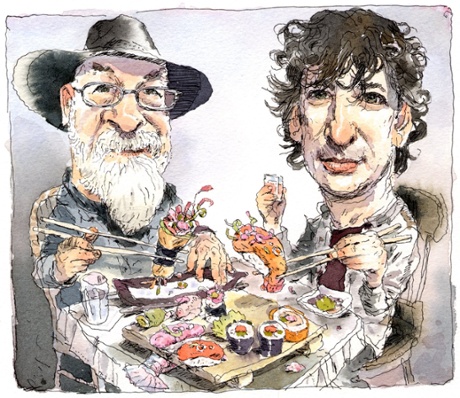
Not a particularly Otherwhilish update this but I wanted to share Neil Gaiman's article for The Guardian about his friend Terry Pratchett.
 The article - warm and sad and unflinching in the way Gaiman does so well - is a great reminder of the way that anger can power writing and particularly comic writing. There is a deep hatred of injustice running through pretty much all Terry Pratchett's novels (particularly the Sam Vimes books). In a world in which we are all encouraged to see ourselves as individuals and to forget all those others without whom it would be impossible for us to survive and thrive, that's exactly the kind of hatred we need.
Subscribe to:
Posts (Atom)